
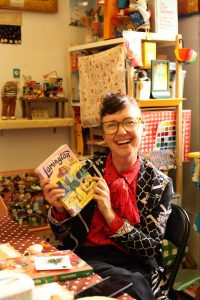
Andrea Innocent has spent years bringing other people’s stories to life on the page – but the story that wouldn’t leave her alone was her own. Her debut middle-grade graphic novel, Lamington Left Behind, has been published by Hardie Grant. Its journey from haunting idea to 304 illustrated pages was shaped, in part, by the courses Andrea – based in Warburton, Victoria – took at the Australian Writers’ Centre, including Writing Middle Grade Fiction.
Andrea had recently returned to full-time work as a freelance illustrator after having a child when she first found her way to the Australian Writers' Centre. She’d started creating stories and writing comics, and wanted to write her first graphic novel. The problem? She didn’t think she could.
“I knew I had a story in me, the characters were haunting me, I just didn’t have the confidence to be able to tell it as I was predominantly an illustrator and had only told stories through images,” she says. “I had the impression I was not a good writer and that I tended to be verbose and didactic.”
Finding the words for a story she’d already imagined
Because so much of a graphic novel lives in the artwork, Andrea wanted to learn to write something that read more like a movie manuscript than a traditional novel. She also needed an original synopsis and dialogue she could use to pitch the project to her publisher.
She found the Australian Writers' Centre’s courses both practical and confidence-building. “I found the instructions very easy to follow as well as giving context to all the reasons we were using a particular process,” she says. “The most useful part of the courses were that they were fun and inspiring. I wanted to learn to write using a process that would make it easier for me to get words on a page without being judgemental. Getting feedback from the teachers at AWC was so wonderful as it allowed me to improve my writing quickly.”
The shift was almost immediate. “I will never forget speaking to an editor at my publishers after my second course and she complimented my writing skills after reading my first draft for the graphic novel,” Andrea says. “I never expected to be ‘good’ at writing so quickly.”
More than anything, she says, the courses gave her permission to put words on the page knowing they wouldn’t be the final word. “I think the courses have most of all just given me the confidence to get something on the page knowing there will be lots of drafts to follow to really make it sing in the final draft.”
Inside Lamington Left Behind
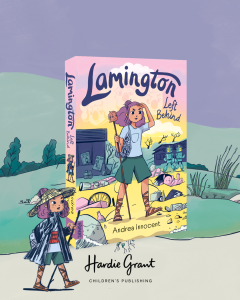 The novel itself is a tender, environmentally minded story for middle grade readers. “Lamington Left Behind is a middle-grade graphic novel about a young girl who accidently gets abandoned during a storm,” Andrea explains. “She is left to fend for herself until one day she meets a group of animals, some strangely familiar to her. They are also surviving after fires and storms have ravaged their forest. They realize the only way they will all be able to return to their homes is by rescuing the seeds and growing the forest again.”
It’s a book that pulls together the threads of Andrea’s life – her illustration practice, her love of the natural world, and her parallel studies in Conservation and Ecosystem management.
304 pages and a lot of drawing
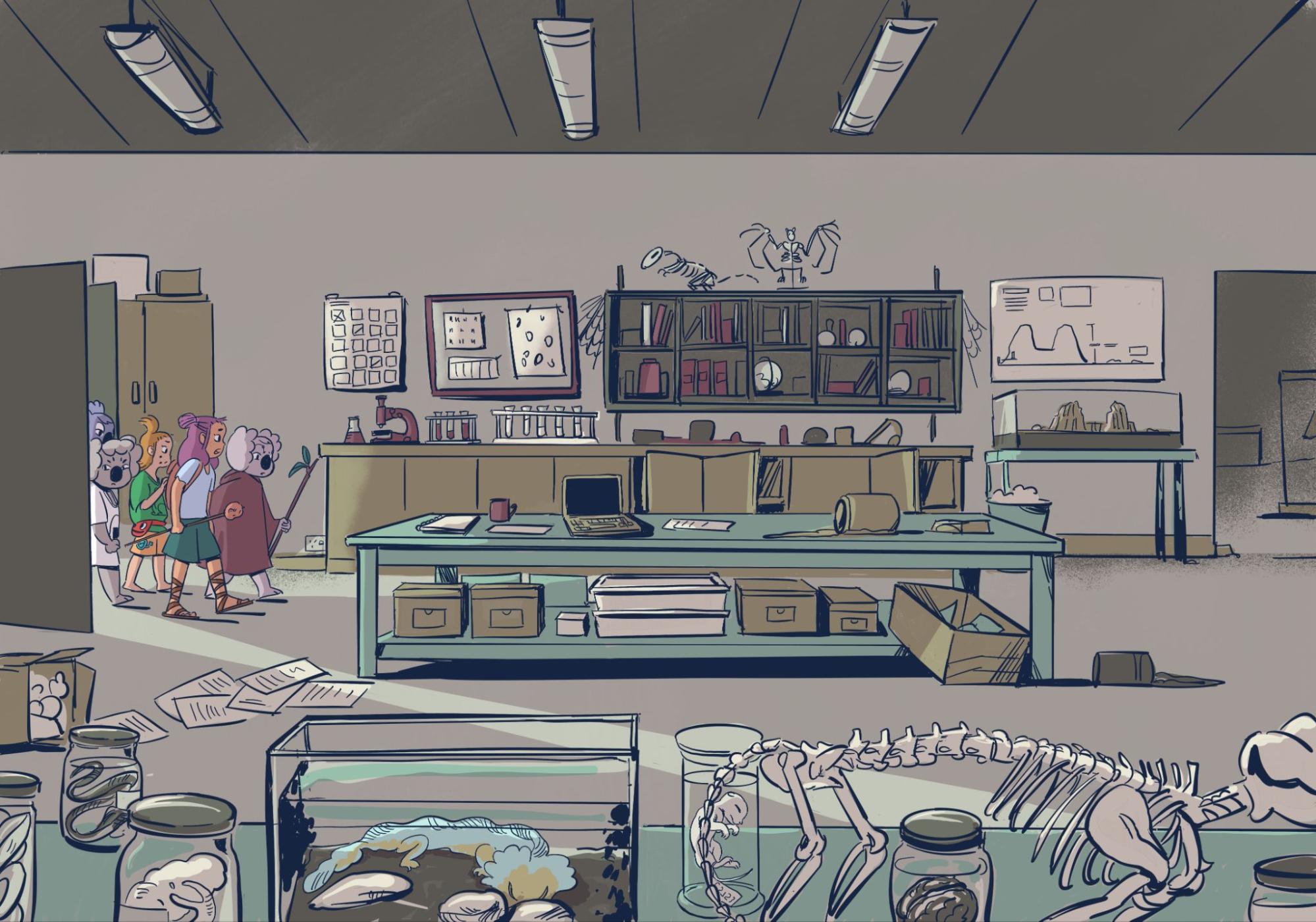
“Much of the writing process is like a movie manuscript with notations and descriptions of the visuals,” she says. “At times I would be moving back and forth from the images to the text. The dialogue would be written along with a description and location of the scene. Whenever I got lost I would go back to writing more in a novel format so I could speed up the process and move things around if they needed to be.”
Once the manuscript was locked in with the publisher, Andrea sketched out all 304 pages, then refined and tweaked them all the way through to the final stages – word bubbles, text and final art with colour.
There were moments she wasn’t sure she’d make it to the end. “There were many times in the process when I wasn’t sure I was going to finish the graphic novel, it’s such a huge amount of drawing,” she admits. “I am very happy I did though.” When she heard the book was being published, she was “so elated. It had taken quite a bit of work to get to that stage and lots of different pitches so I was relieved to have something I could finally sink my teeth into.”
Andrea’s AWC studies also included Writing Middle Grade Fiction, Creative Writing Stage 1, Writing Picture Books and Fiction Essentials: Structure – a stack of courses that fed into the project from different angles, from getting words on the page to shaping a story for young readers.
What’s next
These days, Andrea is balancing illustration, study and writing. She’s currently studying Conservation and Ecosystem management with hopes of becoming a science educator and volunteer coordinator, and uses her writing skills, in her words, “to try to inspire people to look after the natural world.” She’s also working on a children’s picture book with Hardie Grant about a dog who thinks he’s human.
When friends – and even strangers – approach her with picture book ideas they haven’t quite written yet, she knows exactly where to send them. “I have already!” she says, when asked if she’d recommend AWC. “As an illustrator I often get friends and also strangers wanting me to illustrate their ideas for kids' books even though they hadn’t written anything yet. I have sent a few to AWC as they weren’t sure how to go about writing for kids in particular. I explained how fun the assessment tasks were and that it would also motivate them to work on their manuscripts.”
You can follow Andrea on Instagram and Facebook.
Courses taken at AWC: